

By John Cissel
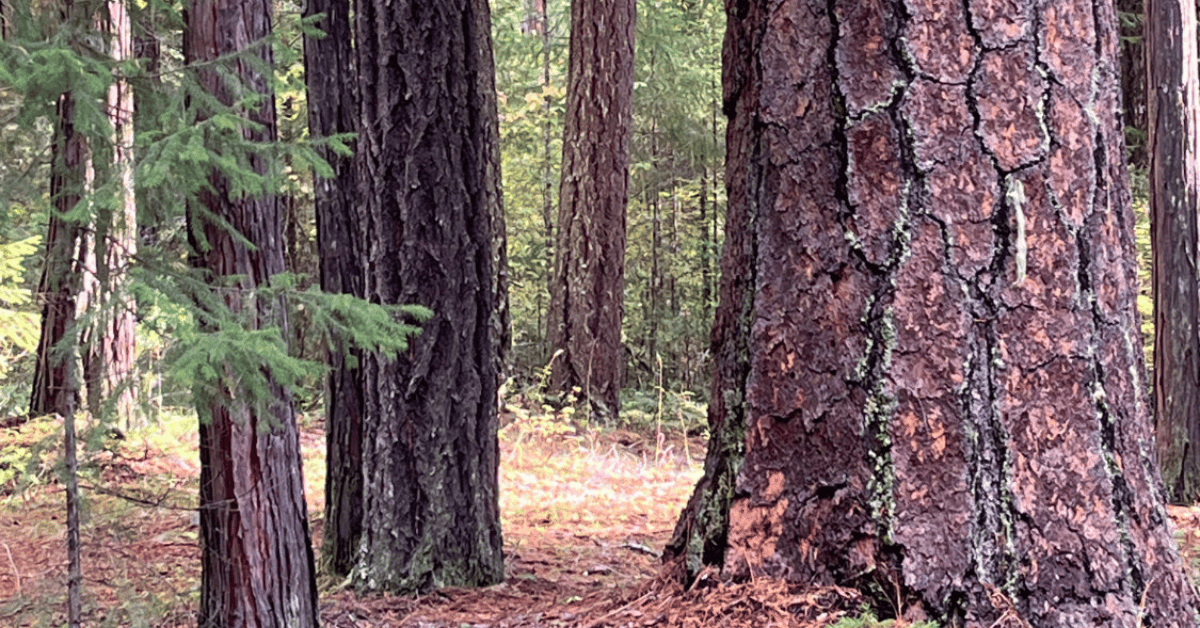
Visitors to old-growth forests may know that these forests are ecologically important, but for most people, myself included, it is the more emotive aspects of an old forest that inspire and motivate us. We are struck by the sheer beauty of the stout, cinnamon tree trunks; the shafts of sunlight highlighting a lush understory of hip-deep ferns; or the gnarly forms of broken and twisted moss-draped branches. The awe-inspiring dimensions of these giants are globally noteworthy and remind us of our own relative insignificance. Immersion in truly old forests provides a living connection to a pre-European landscape shaped by the forces of nature and indigenous cultures.
Images of enormous Douglas-fir and western redcedar in lush, verdant forest are iconic in the Pacific Northwest. Yet the old forests that hikers actually see are quite variable, including a wide range of forest types shaped by an equally wide range of environmental conditions and history. Experiencing a broad spectrum of old forest conditions is a great way to connect ecological forces with your own perspectives on the importance of old forests.
A brief summary of a few hikes in the Willamette National Forest illustrating some of this diversity is provided below. I hope these images and descriptions encourage you to get out and appreciate these majestic old forests, and enrich your understanding of the forces shaping their history and future.
Detailed maps, ecological and hike descriptions, and photos for each of these hikes, and many others, are freely available at https://oldgrowthhikespnw.org/
The website linked above contains the newly updated 3rd edition of “50 Old-Growth Hikes in the Willamette National Forest,” last revised in 1998. This guide was one of a series of annotated old-growth guide-maps and a book I authored and published from 1991-2003.
A great resource for a statewide look at old-forest hikes is “Oregon’s Ancient Forests: A Hiking Guide” by Chandra LeGue.
Lookout Creek (McKenzie Watershed, Hike 24)

| Length | 3 ½ miles one way |
| Difficulty | Moderate |
| Season | Spring to autumn |
| Elevation range | 2,430 feet – 3,440 feet |
| Human Imprint | Minimal |
| Information | Willamette National Forest, McKenzie River Ranger District |
The Lookout Creek Old-Growth Trail is a great place to sample classic Douglas-fir-western hemlock old growth. It is classic, in part, because it is located in the HJ Andrews Experimental Forest, where research into old-growth ecology began over 50 years ago and continues today. Old-growth stands like this were used to construct some of the initial definitions of old-growth forests. Big Douglas-fir, a well-developed understory of western hemlock, and abundant large snags and down wood characterize much of the lower slopes along this trail. Large western redcedar cluster near tributary streams.
Three Pyramids (South Santiam Watershed, Hike 12)

| Length | 2 ¼ miles one way |
| Difficulty | Difficult |
| Season | Summer to Autumn |
| Elevation range | 3,940 feet – 5,618 feet |
| Human Imprint | Low (mountain bikers) |
| Information | Willamette National Forest, Sweet Home Ranger District |
The hike up to the scenic summit of Middle Pyramid illustrates the effect of increasing elevation on the type of old forest. Cold-hardy noble fir mixes with Douglas-fir along the first part of the trail, and becomes more dominant with increasing elevation. Mountain hemlock makes an appearance as the trail ascends the secondary ridge on the way to the top. Higher elevations mean a deeper and longer-lasting snowpack which favors true firs and mountain hemlock. The long, seemingly taper-free noble fir trunks in the lower part of the stand stretch skyward to impressive heights lending a strong vertical feel to the stand. The view of the high Cascades from the top is ample reward for the uphill climb.
South Waldo (Middle Fork-East Watershed, Hike 41)

| Length | 3 ½ miles one way |
| Difficulty | Moderate |
| Season | Summer to early autumn |
| Elevation range | 5,440 feet – 6,050 feet |
| Human Imprint | Minimal |
| Information | Willamette National Forest, Middle Fork Ranger District |
The high-elevation slopes south of Waldo Lake host some of the finest mountain hemlock old growth in the Oregon Cascades. The South Waldo hike traces the lake margin for a couple of miles before heading uphill through the northern end of this forest. The Island Lakes Loop (Hike 43) provides a longer option through the heart of this splendid stand.
Echo Basin (McKenzie Watershed, Hike 16)

| Length | 2 ½ mile loop |
| Difficulty | Moderate |
| Season | Summer to early Autumn |
| Elevation range | 4,160 feet – 4,900 feet |
| Human Imprint | Moderate (plantation) |
| Information | Willamette National Forest, Sweet Home Ranger District |
Echo Basin sits in the palm of a sheltered drainage where cold air pools, fostering a forest similar to those found around Mount Rainier and farther north. A short loop leads hikers through this forest where impressive Alaska cedar and occasional old noble fir stand by the trail. Alaska cedar are usually short and sometimes almost shrubby in Oregon, but in Echo Basin they form large trees, likely the largest Alaska cedar in Oregon.
Middle Fork – Sacandaga (Middle Fork-East Watershed, Hike 49)

| Length | 2 ½ miles one way |
| Difficulty | Easy |
| Season | Spring to autumn |
| Elevation range | 2,470 feet – 2,560 feet |
| Human Imprint | Moderate (FR 21 and other roads close by; nearby plantations) |
| Information | Willamette National Forest, Middle Fork Ranger District |
An extensive area of dry mixed conifer forest occupies lower and south- or southwest-facing slopes above Hills Creek Reservoir on the southern end of the Willamette National Forest. This forest contrasts strongly with the forest types described above, both in terms of the species present and in the fire history of the area. An era of frequent fire, supported by indigenous burning, persisted for centuries or millennia maintaining an open forest of large ponderosa pine, sugar pine, incense cedar and Douglas-fir in near-savannah conditions. Unfortunately, a subsequent era of fire suppression led to a dense midstory and understory of grand fir, Douglas-fir and incense cedar that now competes with the older trees for water and nutrients while greatly increasing the amount of fuel in the forest. Many of these older legacy trees are being out-competed by these younger trees, especially the old pines which are dying out. This hike provides an easy way to see this forest condition before the trail heads downslope into a more mesic riparian forest. The Middle Fork – Coal Creek hike (47) and Youngs Rock hike (46) provide alternatives to viewing a forest type more typical in southern and eastern Oregon.
French Pete Creek (McKenzie Watershed, Hike 27)

| Length | 1 ¾ – 4 miles one way |
| Difficulty | Easy – Difficult |
| Season | Summer to autumn |
| Elevation range | 1,840 feet – 2,800 feet |
| Human Imprint | Minimal |
| Information | Willamette National Forest, McKenzie River Ranger District |
Fire has played a central role in the formation and persistence of old forests in the western Cascades for millennia. Fires vary in frequency, intensity and size historically forming characteristic patterns of fire behavior and effects across areas of similar environmental conditions. Unfortunately, an era of fire suppression, followed by rapid and significant climate change, have greatly altered fire patterns and effects. Many old forests have burned severely in recent years where severe fire had been absent for a long time. Opal Creek (formerly hike 1) and Opal Lake (formerly hike 2) are two prominent examples. Many hikes in recently burned areas are still effectively closed. The French Pete Creek trail offers an opportunity to observe mixed fire effects. The Rebel Fire (2017) and Terwilliger Fire (2018) burned with moderate severity in this area leaving most large trees scorched but alive. However, most understory and mid-canopy trees were killed by the fires, and small patches of forest were severely burned killing the older overstory trees as well. Many existing old forests show signs of similar fires in the past, including fire-scorched large trees and groups of trees having a similar age in the post-fire understory and midstory.