


Trump 2.0: Looting Oregon’s Treasures
How Congress and the Trump administration’s rollbacks to environmental protections threaten some of our favorite places
In 2025, Trump-led proposals have prioritized the dramatic increase of logging, mining, and grazing that threaten the ecological values of our public lands, jeopardizing habitat, clean water, and recreation. But, even more alarmingly, the very idea of public lands has come under attack as well, as the Trump administration and its allies in Congress seek to dismantle the tools the public has to understand and engage with their management.
We can’t let this administration loot and pillage our natural heritage for private profit. Our public lands are too important. As co-owners of these forests, rivers, deserts, mountains, and plains, we have a responsibility to defend the lands themselves and the democratic tools that are central to the idea of public lands. Block by block, Oregon Wild is working to thwart Trump’s dismantling of what we hold dear.
In this report, we highlight some examples of Oregon’s treasured places at risk, as well as how we are fighting for these places day in and day out, for the public’s voice, and for a future where nature doesn’t just survive, but thrives.
Treasured Places at Risk
-
Mount Hebo: Nestucca River Headwaters
Recognized as a State Scenic Waterway and, in places, a federal Wild & Scenic River, the Nestucca River flows through Bureau of Land Management lands and the Siuslaw National Forest as it cuts through the Coast Range and makes its way to the ocean. Its waters are home to steelhead, cutthroat trout, chum, Coho, and Chinook salmon, Pacific lamprey, and other native fish.
Rising above it is Mount Hebo, one of the largest remaining intact forest areas in the Coast Range – nearly 14,000 acres are designated as a roadless area. Headwater streams that feed the Nestucca originate on the mountain’s north side. Trails through the area have been used by Indigenous people as well as settlers for thousands of years, connecting the northern Coast Range and the Willamette Valley.
Many of the forests in this part of the Coast Range have recovered naturally from large fires in the early 20th century, but remnant mature and old-growth forests remain around Mount Hebo, providing important habitat for threatened northern spotted owls and marbled murrelets, rare red tree voles, and elusive amphibians. The summit of Mount Hebo is also home to the largest population of threatened silverspot butterflies in Oregon – for whom Oregon Wild worked to secure federal protection.
Primary Threats
- Increased logging directed by the Trump administration could harm Mount Hebo’s forests if the Roadless Rule is repealed and if the Northwest Forest Plan is revised to allow for logging in older forests. Trump’s timber E.O. included this area in the targeted landscape.
- Weakened ESA: Several native species in this area are listed as threatened under the Endangered Species Act, including the northern spotted owl, marbled murrelet, and salmon. Weakened protections could lead to more habitat destruction.
- Surrounding management: Increased logging on the nearby Tillamook State Forest and BLM lands could have negative impacts on intact habitat, water quality, and scenic values.
Opportunities for Action
- Defending roadless wild lands: Keeping Roadless Rule protections in place will keep Mount Hebo from suffering further forest habitat fragmentation.
- Passing the River Democracy Act: Wild & Scenic River protections added under the RDA would protect several headwater streams flowing from Mount Hebo into the Nestucca River, maintaining fish habitat and water quality.
- Forest defense: The Northwest Forest Plan designates most of this area as a Late Successional Reserve, limiting commercial logging to previously logged young forests for restoration purposes. Ensuring these restrictions remain in place when the forest plan is revised is important for protecting mature and old-growth forests and the wildlife that depend on them.
- Wildlife conservation funding: State funding to restore and protect habitat for threatened species will help ensure thriving pop
Visit Mount Hebo
Hike from Hebo Lake to the mountain’s summit, or even drive there for expansive views. Learn more.
-
The Oregon Dunes
The Oregon dunes stretch across the central coast of Oregon, forming a dynamic landscape that depends on shifting sand to sustain its native ecology. In 1972, Congress designated this 31,500-acre section of the Siuslaw National Forest as a National Recreation Area in recognition of its unique ecological and recreational value. Four blocks of the dunes area totaling 26,000 acres are also designated as roadless areas protected by the Roadless Area Conservation Rule.
As one of the world’s largest temperate coastal dune systems, it attracts thousands of visitors each year for camping, hiking, paddling, and off-road vehicle riding; and it provides habitat for a variety of plants and animals—some found in few other places. This native ecosystem is threatened today due to introduced beach grass that has stabilized and changed the dunes, leading to the decline of some native species.
Restoration of the Oregon dunes has been a priority for the Forest Service for several years, and Oregon Wild has worked to support these efforts as well as seeking protection from development strains. Several streams that flow lazily through the dunes, like Takenitch Creek and Tenmile Creek, are proposed as Wild & Scenic Rivers under the River Democracy Act.
Primary Threats:
- Reduction in staff and funding for restoration: With the Trump administration’s direction to focus exclusively on timber production and other extractive activities on public lands, funding and staffing for ecosystem restoration, monitoring, and enforcement will be severely restricted. In places like the Oregon dunes, this means that ongoing work to remove invasive plants and restore habitat for rare and threatened plants and animals is on the back burner. Partnerships with non-profits and volunteers may be the only way this work can continue in the coming years.
- Weakened ESA: Several native species in this area are listed as threatened under the Endangered Species Act including the Pacific marten, snowy plover, and Siuslaw hairy necked beetle. Weakened federal protections could mean a further decline for these wildlife and plants.
Opportunities for Action
- Defending roadless wild lands: Keeping Roadless Rule protections in place will ensure habitat integrity for sensitive native species and maintain the numerous recreational opportunities popular here, while keeping development pressures at bay.
- Passing the River Democracy Act: The natural beauty, unique plants, recreation opportunities, and wildlife values of the dunes area is tied to its streams and lakes. Wild & Scenic River protection would protect these values along the Siltcoos River, and Sutton, Takenitch, Threemile, and Tenmile Creeks.
- Wildlife conservation funding: State funding to restore and protect habitat for threatened species found in the dunes will help ensure thriving populations of these and other species, even if the Endangered Species Act is weakened. The Oregon Dept of Fish & Wildlife have identified the dunes as a significant Conservation Opportunity Area so they are likely to receive funding and support.
Visit the Oregon Dunes
Experience one of the largest expanses of open sand dunes from the Dellenback trailhead south of Reedsport. Learn more.
-
Oregon Redwoods: Still standing tall
The tallest trees on Earth, coast redwoods are the ultimate ancient trees, sometimes living more than two thousand years. Most people think of the towering coastal redwood forests of California, but these mighty trees also sneak into Oregon at the northern limit of their range, within the coastal fog zone in the lower Chetco River and Winchuck River watersheds.
Oregon’s redwoods faced near extinction from logging in the 1970s and 1980s, but thanks to Wendell Wood and other forest advocates who drew attention to the plight of Oregon’s redwoods at that time, additional logging plans were dropped. Today, a mere 1300 acres of small groves are scattered on the western edge of the Siskiyou National Forest, on some BLM lands, and in the Alfred A. Loeb State Park. Some can be found in designated roadless areas that surround Emily Creek and the Winchuck River. Some short trails along the Chetco River and on Peavine Ridge help visitors access Oregon’s redwoods. The Northwest Forest Plan’s designations for threatened species habitat protect most of these forests today, but perhaps not for long.
Primary Threats
- Increased logging directed by the Trump administration could harm the remaining redwood forests if the Roadless Rule is repealed and if the Northwest Forest Plan is revised to allow for logging in older forests. Trump’s timber E.O. included this area in the targeted landscape.
- Weakened ESA: Several native species in this area listed as threatened under the Endangered Species Act, including northern spotted owls and marbled murrelets. Part of this area is designated as critical habitat for threatened northern spotted owls, and weakened protections under the ESA could lead to more habitat destruction.
- Public land privatization: Curry County, home to all of Oregon’s remaining redwoods, has proposed to lease public forest lands, including about half of the mapped redwood stands in Oregon, in order to manage them for logging and county revenue. Spurred on by Trump policies and industry supporters, this threat could become real with or without a passed county resolution.
Opportunities for Action
- Passing the River Democracy Act: The River Democracy Act would help protect the streamside corridor along several streams lined with redwood forests and help limit logging that would harm those streams’ important values. These include Moser Creek, Emily Creek, Wheeler Creek, and the Winchuck River and its tributaries.
- Defending roadless wild lands: Keeping Roadless Rule protections in place can help prevent commercial logging of the remaining redwood groves, as many of them are found within roadless areas.
- Forest defense: The Northwest Forest Plan designates this area as a Late Successional Reserve, limiting commercial logging to previously logged young forests for restoration purposes. Ensuring these restrictions remain in place when the forest plan is revised is important for protecting mature and old-growth forests and the wildlife that depend on them.
Visit the Oregon Redwoods
Explore one of the remaining redwood groves in Oregon on this trail just north of the California border. Learn more.
-
Kalmiopsis Wildlands: Rough & Ready Creek
The landscape that surrounds Rough & Ready Creek in southwest Oregon is part of a complex of intact roadless appendages that wrap around the existing Kalmiopsis Wilderness, making this expanse of wild lands the state’s largest. A tributary to the Wild & Scenic Illinois River (and proposed for such designation itself), Rough & Ready Creek runs wild and clear through a unique and ancient geologic wonderland of serpentine soils, rare and endemic plants, and rugged ridges. Native chinook salmon, steelhead and cutthroat trout that have adapted to the naturally high summer water temperatures in this watershed thrive here, and rare yellow-legged frogs flourish in this pristine habitat.
Despite its unique and outstanding botanical diversity, geology, water quality, and wildlife values, the streams in this roadless area are threatened by exploitative nickel mining. Efforts to protect this area from such threats are ongoing on multiple fronts. Currently, the temporary 20-year Southwest Oregon Mineral Withdrawal prevents new mining claims in the Rough and Ready Creek watershed, but existing federal mining claims within the withdrawal area could be mined if found to be “valid.” RNR Resources continues to hold active mining claims in the Rough and Ready Creek area, in what has become Oregon’s longest-running struggle between the protection of beloved public lands and the proponents of the antiquated 1872 Mining Law.
Primary Threats
- Increased logging directed by the Trump administration could harm the forests in the Rough & Ready watershed. Trump’s timber E.O. included this area in the targeted landscape, and repeal of the Roadless Rule and changes to the Northwest Forest Plan could further enable commercial logging
- Mining development: The principal threat to the Rough and Ready Creek watershed is industrialization and large-scale surface mining of ancient low-grade nickel laterite soils. To be economically viable, the mining that threatens this wild remote corner of Oregon and the incredible wild rivers and creeks that flow through it would need to be at a massive scale. This would result in irreparable harm from proposed smelter construction and operation, road building, and strip mining. It would devastate the unique values of this watershed and impact nearby homes on the valley floor and the Illinois River and Cave Junction downstream. Trump’s orders on critical minerals may facilitate streamlined approval for permitting and development.
- Invasive species: In addition to mining, Rough and Ready Creek could be degraded by the invasive Port Orford Cedar root disease if roads and mining are allowed. Rough and Ready Creek is one of the few watersheds of its size which is not infested with this disease in southern Oregon, meaning its high botanical diversity values remain intact.
Opportunities for Action
- Defending roadless wild lands: Keeping Roadless Rule protections will help ensure that increased mining development pressure in the form of roads is limited.
- Passing the River Democracy Act: The River Democracy Act would help protect Rough & Ready Creek as well as some nearby streams flowing into the Wild & Scenic Illinois River. The RDA would extend mineral withdrawals for designated wild and scenic corridors and for Illinois River’s botanical areas, including Eight Dollar Mountain and Serpentine Darlingtonia Wetlands. This will serve as a hurdle to mining operation approval and will require that for any mining activities to proceed in withdrawn areas that the existing federal mining claims must fully comply with the laws of the United States and be valid. Protections under RDA could also help provide impetus for the State of Oregon to put in place other protections, similar to the designation of the North Fork Smith River and its tributaries as Outstanding Resource Waters in 2017.
Visit Rough and Ready Creek
Get a taste of this area’s unique geology and plant life at this Botanical Wayside in the Illinois Valley. Learn more.
-
Lost Lake: Mount Hood reflections
Lost Lake’s resort and campgrounds on the north side of Mount Hood are a favorite destination for families and others seeking tranquil waters for nonmotorized boating, classic views, and pure mountain air. Hikers on the Pacific Crest Trail get a great view of the lake and Lost Lake Butte from the forested ridge to the west, which divides the Hood River drainage from the Bull Run watershed just to the west—the source of Portland’s drinking water.
However, as the drive to the lake reveals, private land in the area is managed exclusively for timber production through clearcutting. The unlogged public forest lands around Lost Lake are vital for species that require intact forests, and for nearby communities that depend on clean water and the economic benefits of recreation.
Development at Lost Lake is currently limited to the existing footprint due to restrictions under the Roadless Rule and on logging old forests under the Northwest Forest Plan. This helps ensure that the old-growth forests that surround the lake and offer such spectacular views and recreation remain standing.
Primary Threats
- Increased logging directed by the Trump administration could harm the forests surrounding Lost Lake if the Roadless Rule is repealed and if the Northwest Forest Plan is revised to allow for logging in older forests. Trump’s timber E.O. included this area in the targeted landscape, as well as the protected Bull Run watershed. A proposal to redesignate some of the existing developed area to a less-restrictive category under the forest plan could also lead to more aggressive vegetation removal that harms scenic values and increases fire risk
- Weakened ESA: Several native species in this area are listed as threatened under the Endangered Species Act, including northern spotted owls and gray wolves. Weakened federal protections could harm these species’ habitat and other things they need to thrive.
Opportunities for Action
- Defending roadless wild lands: Keeping Roadless Rule protections will ensure that increased development pressure is limited and that the habitat connections vital for wildlife and the intact ecosystem between the Hood River watershed and Bull Run watershed remain in place.
- Passing the River Democracy Act: The River Democracy Act would help protect the streamside corridor along the Lake Branch Fork of Hood River that flows from Lost Lake, ensuring water quality downstream.
Visit Lost Lake
Experience the views and ancient forests around Lost Lake on a 3.2 mile loop hike. Read more.
-
McKenzie River Headwaters
The McKenzie River is one of the most iconic in the state for recreation, scenery, and water quality. The Mckenzie River provides clean drinking water to Eugene and other local communities, and its headwater streams and crystal clear water springs are buffered from annual precipitation and temperature fluctuations so they are a reliable source of plentiful cold water. These streams are surrounded by mature and old-growth forests, along with some previously logged plantations, home to native wildlife, including threatened northern spotted owls. They are designated critical habitat for ESA-listed bulltrout, a fish that relies on especially cold water, as well as spring Chinook salmon. Several of the McKenzie’s headwater tributaries are proposed for additional Wild & Scenic River protections under the River Democracy Act, which will enhance the river’s important values and expand benefits for fish, ancient forests, historical and cultural areas, and floodplain and other habitat restoration.
Despite its importance, the McKenzie River watershed has had more than its fair share of aggressive logging. Clearcuts on the Willamette National Forest here began in the mid-19th century, fragmenting much of the expansive ancient forest. The Northwest Forest Plan helped curb this abuse, but today, many forests in the McKenzie River watershed remain open to logging. The planned Flat Country Project would have logged native, mature forests in the vicinity of these headwater areas, degrading habitat for threatened northern spotted owls and other species, and putting at risk the water quality that make these streams so special. While important for fish and wildlife habitat and water quality, many of these tributary streams are not protected from logging outside the core riparian buffer.
Primary Threats
- Increased logging directed by the Trump administration could harm the forests in the McKenzie headwaters if the Roadless Rule is repealed and if the Northwest Forest Plan is revised to allow for logging in older forests. Trump’s timber E.O. included this area in the targeted landscape. Under the Northwest Forest Plan, much of the upper watershed is classified as a logging-emphasis area where increased volume is likely to come from.
- Weakened ESA: Several native species in this area listed as threatened under the Endangered Species Act, including northern spotted owl and bulltrout. Weakened federal protections could further fragment and destroy forest habitat and reduce water quality.
- Reduction in staff and funding for restoration: Watershed restoration has been a priority of the Forest Service in the McKenzie headwaters, helping to protect water quality and fish habitat. But with the Trump administration’s direction to focus exclusively on timber production and other extractive activities on public lands, funding and staffing for ecosystem restoration will be reduced. In addition, the combination of a reduction in staffing and the drive for increased timber production means the Willamette National Forest is using policies designed to cut out the public and use private contractors to develop large-scale logging projects, such as the Tie Project in the upper McKenzie.
Opportunities for Action
- Defending roadless wild lands: Defending the Roadless Rule would ensure places like the headwaters of White Branch Creek near Proxy Falls, Scott Lake, and McClennan Mountain don’t lose important safeguards against development in the form of roads and logging.
- Passing the River Democracy Act: The River Democracy Act would help protect streamside corridors along 113 miles of headwater streams in the McKenzie. This includes the South Fork McKenzie, Horse Creek, Deer Creek, Blue River, and Olallie Creek. This would limit any logging that would harm water quality and threatened fish habitat.
- Forest defense: The Northwest Forest Plan designates part of this area as Late Successional Reserve, limiting commercial logging to previously logged young forests for restoration purposes. Other parts of the upper McKenzie have fewer logging restrictions, though we have had past success in stopping damaging logging projects like the Flat Country project. Ensuring forest plan protections remain in place as it is revised is important for protecting mature and old-growth forests and the wildlife that depend on them.
Visit the upper McKenzie
Explore the upper-most headwaters of the McKenzie River at Clear Lake with a hike or on the water. Learn more.
-
Tumalo Creek Watershed
Tumalo Mountain forms a well-known scenic backdrop for the drive to Mt. Bachelor or further on the Cascade Lakes Highway. The nearly 15,000 acres of wild roadless lands that surround it serve as a vital hub for recreation and is the source of clean drinking water for over 100,000 residents in Bend.
Miles of trails crisscross the Tumalo Mountain Roadless Area – offering shady streamside summer hiking and winter snowshoe and backcountry skiing adventures. The protected forests surrounding Bridge Creek, Tumalo Creek, and its forks safeguard Bend’s drinking water and support the area’s craft brewing industry as these wild streams await designation as Wild & Scenic Rivers under the River Democracy Act.
Primary threats
- Increased logging directed by the Trump administration could harm the forests in the Tumalo Creek watershed if the Roadless Rule is repealed. Trump’s timber E.O. included this area in the targeted landscape. While much of the area is withdrawn from logging, downstream of the roadless area and outside of the riparian zone, the forest along Tumalo Creek is in a land use allocation that could see more aggressive logging under Northwest Forest Plan changes, especially when coupled with the mandates to increase timber production from National Forests. Increased logging in this area would threaten the values important to local residents, businesses, and visitors.
- Roadless Rule repeal: Development pressures are high in this area so close to Bend and high-use recreation areas. Without roadless rule protections, new roads could be punched into the core of this wild area, harming wildlife, quiet recreation, and scenic values.
- Weakened ESA: Native species in this area listed as threatened under the Endangered Species Act include northern spotted owls, Oregon spotted frogs, and gray wolves. Weakened federal protections could mean additional harm to these species’ habitats.
Opportunities for Action
- Passing the River Democracy Act: The River Democracy Act would help protect Bridge Creek and Tumalo Creek, ensuring Bend’s drinking water is protected, along with the streams’ other values.
- Defending roadless wild lands: Defending the Roadless Rule would ensure Bridge and Tumalo Creeks remain protected from new roads and commercial logging that could harm the recreational values people flock here for as well as other public values.
- Wildlife conservation: State funding to restore and protect habitat for native species will help ensure thriving populations of these and other species, even if the Endangered Species Act is weakened.
Visit the Tumalo Creek watershed
Discover this area, including a suggested loop hike. Learn more.
-
Newberry Caldera and Paulina Lakes
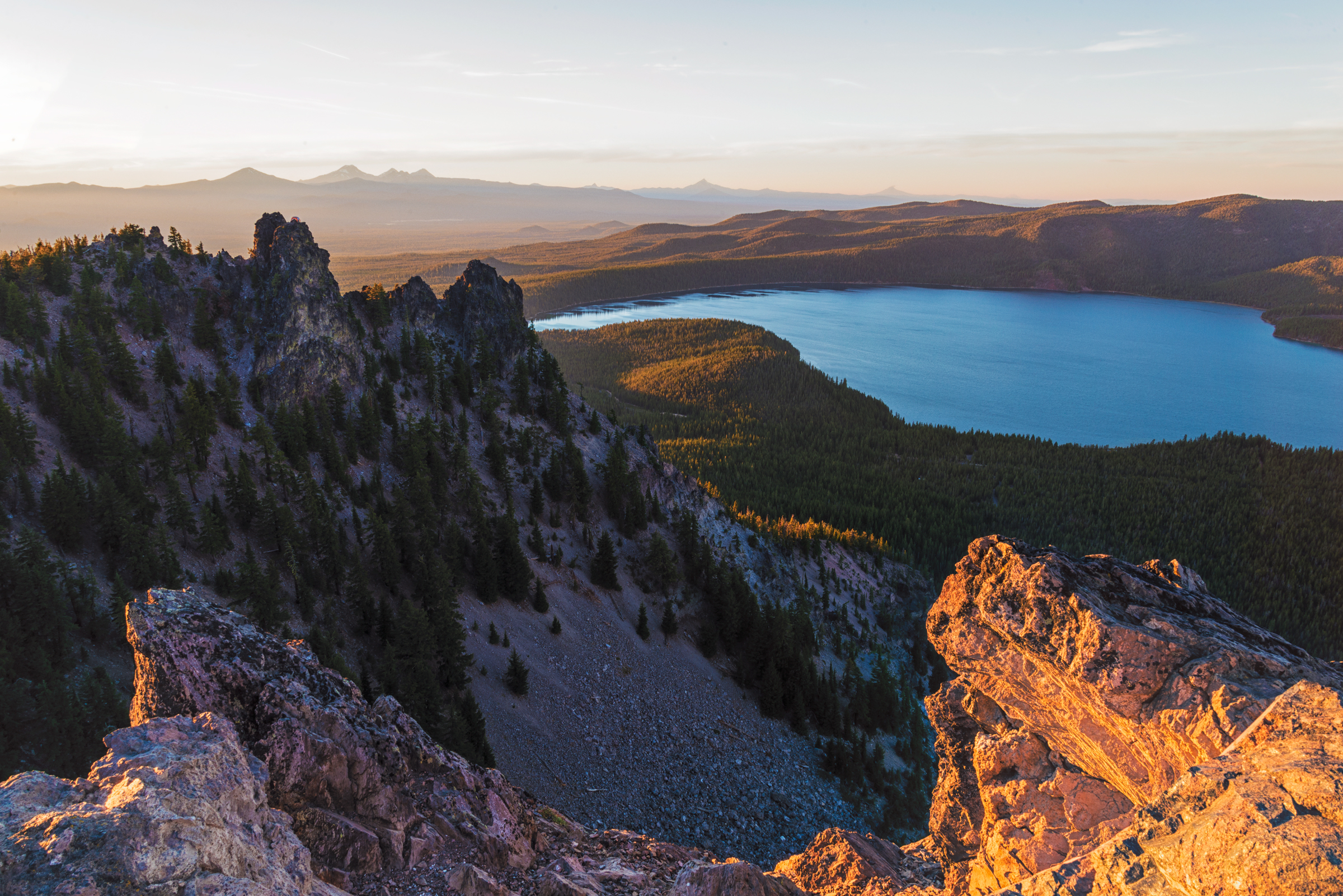
The Newberry Volcanic National Monument was designated in 1990 and includes over 54,000 acres of the still-active shield volcano and its past lava flows. The Newberry Caldera (or Crater) section rises above the surrounding valley, and Paulina and East Lakes fill in a few of the craters at the top of the monument. Paulina Peak rises to nearly 8,000 feet high on the old caldera’s rim. In the surrounding national forest, you’ll find obsidian lava flows, pumice flats, and ancient forests and rare vegetation that thrive in the harsh environment.
Recreation is front and center at Newberry Crater, with a small resort, campgrounds, hiking trails, waterfalls, and motorized and non-motorized winter sports. Because of the shallow magma chamber sitting before this still-active volcano, geothermal activity can be found through natural vents and warm springs.
This geothermal activity is also interesting to energy development companies who have long sought access to this heat source. The National Monument’s management plan and protections under the Roadless Area Conservation Rule currently prevent damaging infrastructure development to facilitate energy production, and help maintain the unique scenic, geologic, and ecosystem values in this area.
Primary Threats
- Increased logging directed by the Trump administration could harm the forests in the Newberry Caldera if the Roadless Rule is repealed by opening them up for new roads and development access. Trump’s timber E.O. included this area in the targeted landscape, meaning the pine and mountain hemlock forests could also be targeted for logging.
- Geothermal drilling and development: The “Unleashing America’s Energy” Executive Order seeks to remove barriers to energy production, and without Roadless Rule protections, such development could expand, damaging scenic and recreational values.
Opportunities for Action
- Passing the River Democracy Act: The River Democracy Act would help protect Paulina Creek, which drains from the high lakes inside the caldera, flowing over waterfalls and slides and past campgrounds and a popular trail.
- Defending roadless wild lands: Defending the Roadless Rule would help prevent damaging development and infrastructure proposed as part of geothermal energy development in 28,000 acres of the Volcanic Monument. The Rule also helps protect rare plants like the pumice grape fern from impacts of heavy equipment and other habitat disturbance.
Visit Newberry Caldera
Find trail and camping information for the National Monument and check out the Peter Skene Ogden Trail along Paulina Creek in our River Democracy Act hike collection.
-
Lookout Mountain: Heart of the Ochocos
The forests of the Ochoco National Forest have been heavily impacted by human management—from the obvious effects of logging to the less obvious results of livestock grazing and suppression of natural fire cycles. Logging here included “high-grading,” which removed the biggest, oldest trees across the landscape, leaving true ancient forests with all of their components as a rare feature in Central Oregon.
Lookout Mountain lies at the heart of a vast wild landscape of ponderosa pine and mixed conifer forests, grasslands and meadows, and streams that is ideal for all forms of backcountry recreation. Conservationists have long sought to codify the protections for the designated roadless area and add other protections, including designating Brush Creek and Canyon Creek as Wild & Scenic Rivers under the River Democracy Act.
Primary threats
- Increased logging directed by the Trump administration could harm the forests on Lookout Mountain on a number of fronts. Trump’s timber E.O. included this area in the targeted landscape, and repeal of the Roadless Rule could open the area to more roads and commercial logging. The Trump administration’s effort to remove large-diameter tree protections under the “Eastside screens” could also mean more logging of the landscape’s largest and most fire-resistant trees.
- Reduction in staff and funding for restoration: With the Trump administration’s direction to focus exclusively on timber production and other extractive activities on public lands, funding and staffing for ecosystem restoration (such as managed fire), monitoring for activities like grazing, and enforcement for off-road vehicle use or unauthorized mining will be severely restricted.
Opportunities for Action
- Passing the River Democracy Act: The River Democracy Act would help protect Brush, Lookout, and Canyon Creeks, which flow from Lookout Mountain, and the forests that surround them.
- Defending roadless wild lands: Defending the Roadless Rule would help prevent damaging development such as mining and commercial logging in the 14,000 acres wild area.
Visit Lookout Mountain
Experience the diversity of this wild area on a loop trail through forests and meadow. Learn more.
-
Joseph Canyon
At a combined 45,000 acres, the rugged, remote roadless areas in the northeast corner of Oregon are rich in water, wildlife, and cultural values. The streams that flow into and form Joseph Canyon and the nearby Wildhorse Roadless area are vital headwaters of the world-famous Grande Ronde River, recognized by their inclusion in Senator Wyden’s River Democracy Act. A connector between the Rocky Mountains and Cascades, scientists have identified the area as a wildlife connectivity corridor of global importance – home to elk, bear, bighorn sheep, grey wolves, deer, and even moose. The area is also being considered as a reintroduction site for California Condor by the Nez Perce Tribe.
The area has significant cultural and religious value to the Nez Perce Tribe. It is the birthplace of Chief Joseph, dense with archeological sites, hunting, fishing, and gathering grounds, and is adjacent to the tribally managed Precious Lands.Unfortunately, even the remote backcountry is constantly threatened with proposals for logging, livestock, mining, and road-building in this area.
Primary threats
- Increased logging directed by the Trump administration could harm the forests surrounding Joseph Canyon in several ways. Trump’s timber E.O. included this area in the targeted landscape, and repeal of the Roadless Rule could open the area to more roads and commercial logging. The Trump administration’s effort to remove large-diameter tree protections under the “Eastside screens” could also mean more logging of the landscape’s largest and most fire-resistant trees. And, revisions to the forest management plan could result in additional weakening of logging and streamside protection standards. The Wallowa-Whitman National Forest already has several logging projects planned or ongoing, including the controversial Lower Joseph project. Authorities to streamline planning and bypass analysis can speed up other large landscape logging projects.
- Weakened ESA: With several native species in this area listed as threatened under the Endangered Species Act, weakened protections could have a big impact in this area.
Opportunities for Action
- Defending roadless wild lands: Keeping Roadless Rule protections in place will ensure habitat integrity and connectivity for sensitive native species. A recent proposal to reopen a rugged road separating two of Oregon’s largest roadless areas to facilitate logging is evidence of the potential for road-building demand should the rule be repealed.
- Passing the River Democracy Act: Wild & Scenic River protection would ensure the scenic, cultural, and ecological values of Joseph Creek and its major tributaries in Joseph Canyon are protected.
- Wildlife conservation funding: State funding to restore and protect habitat for species like the California condor, great grey owls, and bighorn sheep native to Joseph Canyon, will help ensure thriving populations of these and other species, even if the Endangered Species Act is weakened.
Visit Joseph Canyon
Take in the grandeur of Joseph Canyon at this roadside viewpoint complete with interpretive signage. Learn more.
Threats
-
Trump Executive Orders
From “Unleashing American Energy” (Executive Order 14154) to “Immediate Expansion of American Timber Production” (Executive Order 14225) President Trump wasted no time in issuing executive orders (EOs) to dramatically expand mining, oil & gas extraction, and logging across federal public lands in his second term. Both orders direct federal agencies to dismantle regulations and policies that protect the environment and public interest in favor of a dramatic expansion of timber harvest and oil, gas, and nuclear energy production from public lands. These changes are to the benefit of wealthy corporate interests and at the expense of public involvement.
A follow up memo in April from Secretary of Agriculture Brooke Rollins (Memorandum 1078-006 entitled “Increasing Timber Production and Designating an Emergency Situation on National Forest System Lands.”) directs the Forest Service to use emergency declarations under the guise of wildfire and insect control to cut corners when it comes to following environmental laws and doing environmental impact assessments when planning and implementing logging projects.
By fabricating these emergencies, the Trump administration is laying dangerous groundwork to further bypass critical environmental laws and long-standing public safeguards. Coupled with legislation, rollbacks of environmental laws and policies, and cutting out public input, these orders could have devastating effects as they take effect. -
Congressional legislation
The threats to public lands are not limited to Trump’s direct orders. Members of Congress have also been trying to reduce public oversight and even, at one point last year, to sell off public lands altogether.
The public lands sale provisions, led by Utah Senator Mike Lee, were initially included in the “Big Beautiful Bill”, but failed thanks to a huge public backlash. Other provisions in the final budget bill, enacted in July 2025, advance Trump’s agenda, including increasing timber production by a minimum of 250 million board feet over previous years’ sale volume for the Forest Service and 20 million for Bureau of Land Management. This arbitrary increase in logging will occur regardless of the impacts it could cause, be it worsening wildfires due to clearcutting or reducing our federal forests’ climate and clean water benefits.
Other legislative efforts attempting to diminish public involvement and expedite public land exploitation are also advancing in Congress.
The so-called Fix Our Forests Act (S. 1462), for example, would severely limit citizens’ ability to comment on and influence how public lands are managed. It would also reduce the amount of environmental review for logging projects up to 15 square miles in size by expanding the use of categorical exclusions. These exclusions were originally intended for small or emergency purposes but are increasingly used to avoid public scrutiny on commercial projects.
Despite claims that the bill addresses wildfire, its main purpose is to increase logging. It provides no safeguards for old-growth forests or clean water and weakens the Endangered Species Act, making it arguably the most damaging logging bill since the 1995 “Salvage Rider.”
Other dangerous bills continue to be introduced as well.
-
NEPA rollbacks, streamlined authorities
The National Environmental Policy Act (NEPA) has long been a scapegoat for industry claims that considering environmental impacts and public input hold up logging, mining, drilling, and other development projects. Under Trump, the Department of Agriculture and the Department of the Interior have both been directed to strip important NEPA provisions applied to our public lands. Rule changes implemented in July limit public involvement and agency transparency when developing projects.
For example, these changes allow for declaration of an emergency to allow projects to move forward before NEPA’s required environmental analysis is completed.
-
Weakening the Endangered Species Act
Through a series of Executive Orders and direction to federal agencies, the Trump administration is also laying waste to the Endangered Species Act (ESA). These actions first resulted in changing the definition of “harm” to species to exclude habitat modification. This change makes it easier for activities such as logging and mining to destroy the places where fish and wildlife feed, shelter, and reproduce. It also continues the long-term trend of shifting responsibility for protecting species from the federal government to the states, which often have fewer resources and, in some cases, open hostility to conserving native species.
An additional rule change proposal would eliminate the US Fish and Wildlife Service’s long-standing “blanket rule” which extends protections to newly listed species while more concrete habitat protection and recovery plans are being developed. And new requirements for officials to consider economic impacts of protecting critical habitat would increase industry influence and reduce the role of science in agency decisions.
The result of these changes is that species already on the brink of extinction will be subject to even more activities that push them closer to the edge and make it harder to reverse that trajectory.
-
Management plan changes
Forest management plans help guide decisions around where logging and other activities can take place in national forests, including delineating sensitive habitats, buffers for streams, and areas of old growth. In western Oregon, the 1994 Northwest Forest Plan (NWFP) overlays seven national forests and is one of the most comprehensive wildlife and habitat conservation plans in the U.S. It was created due to the urgent need to protect our remaining old-growth forests and recover a landscape devastated by widespread ancient forest clearcuts.
An amendment proposal for the NWFP that began under the Biden administration in 2024 would have allowed increased logging of mature forests and freeze progress toward recruiting future old growth. Under the Trump administration, even these rollbacks are not considered sufficient. At the behest of the logging industry, officials have announced that they will reopen the proposal for further weakening, with a draft release date in the fall of 2026.
Meanwhile, three national forests in eastern Oregon’s Blue Mountains (the Malheur, Umatilla, and Wallowa-Whitman) are undergoing their own plan revisions. Unfortunately, the Forest Service has spent the last six years working with an exclusive group of interests primarily aligned with extractive industries. All signs point to another proposal to weaken existing environmental protections or make them unenforceable. Previous proposals have downplayed the conservation opportunities that scientists say are necessary to achieve climate and biodiversity goals and a just transition to more sustainable economies that are better for local communities and the environment. It also seems likely that the long-standing “eastside screens” that protect large-diameter trees throughout eastern Oregon will be discarded in the new forest management plans, opening up the most carbon-rich and fire-resilient forests to increased logging.
-
Eastside Screens repeal
In eastern Oregon, decades of reckless and nearly unconstrained old-growth logging left the region with a deficit of large and old-trees. That trend was slowly reversing under the Eastside Screens, a policy put in place in the early 1990s in an effort to protect the largest trees left on the landscape in eastern Oregon and Washington. This policy prohibited the logging of trees over 21” in diameter. A rushed effort by the first Trump administration to revoke these protections was ultimately found to be illegal, and the protections remained in place after the 2024 court ruling. However, the Trump administration is now looking to reinitiate the effort to remove protections for large trees.
-
Roadless Area Conservation Rule repeal
In the summer of 2025, the Trump administration revealed its proposal to repeal the 2001 Roadless Area Conservation Rule. The Rule protected nearly 60 million acres of wild, undeveloped public lands across the country, including 2 million acres in Oregon, from new roads and commercial logging. Repealing the rule could open pristine backcountry areas to these damaging activities, putting at risk favorite recreation sites, important cultural sites, wildlife habitat, and drinking water. The public comment period ending in September generated 600,000 comments, with 99% of those weighing in opposed to repealing the rule. The draft Environmental Impact Statement on the proposed repeal is likely in spring 2026.
-
BLM Public Lands Rule rollback
Before President Biden left office, the Department of Interior finalized an important change to how Bureau of Land Management lands are managed, adding conservation as a co-equal value to be considered alongside oil and gas leasing, mining, grazing, and other development. The proposed rescission of this rule under Trump, announced in September 2025, means there could be one less hurdle to implementation of his Executive Orders on timber and energy production on these public lands.
-
Dismantling federal agencies and funding
Reducing the federal workforce and restructuring federal agencies has been another priority of the Trump administration through his Department of Government Efficiency and other policies. Many career biologists and public lands managers were forced to take early retirement, others were flat-out fired. This purge has led to a loss of capacity to provide expertise and oversight on our public lands. The US Department of Agriculture has reportedly lost around 20,000 from its workforce. Of those, the Forest Service lost the most employees: 5,860, about 16 percent of its total workforce. The Fish and Wildlife Service, under the Department of the Interior, has also experienced a 20 percent reduction in its workforce, with a significant number of those employees being biologists.
This loss of institutional knowledge, expertise in science and research, and skilled project managers familiar with the landscape and laws and policies that protect sensitive areas and wildlife is just the most obvious consequence of the cuts.
Federal funding cuts for restoration and conservation projects also mean that efforts to aid salmon recovery and reduce fuels through prescribed fire are being sidelined.
Proposed reorganization and relocation of Forest Service and BLM offices also means a loss of public accessibility and local knowledge. The proposal would consolidate nine regional offices into five, and all research stations into just one location. For example, rather than having an office in Portland to oversee Washington and Oregon’s 17 national forests, the Trump administration is proposing to consolidate research and management staff in Colorado.
-
Privatization of public lands
While Senator Lee’s public lands sale proposal was defeated last year, some politicians are still attempting to advance public land disposals. Even when proposals don’t appear to sell public lands outright, the ultimate purpose is to turn over management authority to bypass public transparency and accountability. For example, Curry County in southwest Oregon introduced a resolution in 2025 – blatantly tied to President Trump’s executive order on logging – with a bid to “lease” 80,000 acres of federal public land in the county for the purpose of producing timber and funds for the county.
A bill heard by the Oregon State legislature in 2025, and championed by Representative Vikki Breese-Iverson, would have leased the entire Ochoco National Forest to the Oregon Department of Forestry (ODF). If enacted and approved by the federal government, the lease would double the number of acres managed by ODF, which manages to a significantly lower environmental and public process standard than the Forest Service, even under the Trump administration. The bill’s sponsors were uninterested in the fact that ODF is underfunded and ill-equipped for the demands of managing such a vast, multi-use forest, or the complicated legal implications the lease would bring; they merely wanted more logging.
Creating a workforce crisis at the federal level by cutting agency staff and resources plays into another means towards privatizing the management of public land. Authorities that allow for outsourcing analysis, implementation, and oversight of public land projects like logging, such as the Good Neighbor Authority, have been championed by industry interests for years. The Trump administration’s direction to prioritize such authorities, coupled with cuts to federal resources, all but guarantees that the mandated increases in timber output will be met by private contractors or more local agencies like the Oregon Department of Forestry. -
Going rogue
For much of our history, Oregon Wild has focused on efforts to add lasting protections for wild places, rivers, and wildlife. Using the Wilderness Act, we’ve permanently protected more than 2 million acres of Oregon’s most iconic wild landscapes – from Mt. Hood to the Eagle Cap to Diamond Peak. Using the Wild & Scenic Rivers Act, we’ve helped secure protections for wild river corridors along 2,400 miles winding across the state. And procedural rules like the long-standing Roadless Rule seemed to offer the durable protections important to keep more than 2 million acres of wild lands safe from development.
Under the Trump administration, even our most protected areas aren’t safe.
Take the old-growth forests that line the Wild & Scenic Salmon River as it tumbles out of the Salmon-Huckleberry Wilderness in the Mt. Hood National Forest. While commercial logging goes directly and overtly against the purposes for which these lands were granted Wilderness protections by Congress, the Trump administration’s maps released to support Executive Orders on increased logging, target several Wilderness areas, including pieces of the Salmon-Huckleberry. The towering giants along the Salmon River Trail and the Wild & Scenic River could even be felled. This ancient forest is currently protected under the Roadless Rule and as a Late Successional Reserve under the Northwest Forest Plan, but with proposed rollbacks to these protections, this forest isn’t safe.
Even the Bull Run, Portland’s drinking watershed and long protected from human incursion in order to avoid contamination, is targeted by Trump’s orders. Logging was specifically identified as a threat to the watershed in the past, prompting action from the Portland city council and federal protections. But Trump’s logging maps, if allowed to proceed, could reintroduce this threat to the watershed and put clean drinking water at risk.
What we can do
-
Defending roadless wild lands
We will do everything we can to maintain the protections from road building and commercial logging for the 2 million acres of Oregon’s public lands covered by the Roadless Area Conservation Rule. In addition to defending this policy, we are building support for proactive legislation like the Roadless Area Conservation Act, which would codify the Roadless Rule and make it harder for future administrations to revoke its protections.
-
Passing the River Democracy Act
We continue to work towards passage of the River Democracy Act to protect more than 3,000 miles of Wild & Scenic Rivers. These protections would ensure that any proposed logging, mining, or other development in the stream corridors will not harm the stream’s natural and cultural values.
-
Public forests defense
We’ve built added capacity for forest defense. Oregon Wild’s legal team continues to submit scientifically-backed public comments on plans and proposals for increased logging. We’re not only fighting individual logging projects but also working to maintain important protections for mature and old-growth forests, wildlife habitat, and streams in larger scale management plans like the Northwest Forest Plan.
-
Wildlife conservation funding
We’re also not letting the federal government have the last word. Where the state can enact stronger protections for wildlife, climate, or waterways we’re working at that level too. For example, while the federal Endangered Species Act is being gutted, we’re working to pass the 1.25% for Wildlife bill in the state legislature to ensure funding and other resources for wildlife conservation.
-
Grassroots mobilization
We’re mobilizing communities and activists across the state, and we are prepared to fight in court to defend public lands and uphold environmental laws when necessary.